Understanding Your Vedic Astrology Chart: The Ultimate Guide to Your Cosmic Blueprint
Have you ever felt that your standard horoscope doesn’t quite capture the “real you”? While many are familiar with Western zodiac signs, thousands are turning to the ancient wisdom of a Vedic astrology chart to find deeper clarity. Also known as a Kundali or Birth Chart or D1 chart, this celestial map serves as a snapshot of the heavens at the exact moment of your birth.
What is a Vedic Astrology Chart?
Unlike the circular wheel used in Western systems, a Vedic astrology chart is typically drawn as a square or diamond-shaped diagram. It is based on the Sidereal Zodiac, which tracks the actual observable positions of stars.
This system is often considered more “astronomically accurate” because it accounts for the Earth’s slight axial wobble over time. Consequently, your rising sign and Moon sign in a Vedic reading might be different from what you’ve always believed!
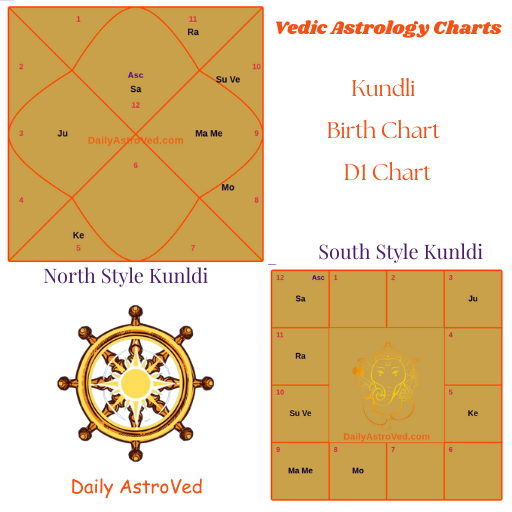
Here’s an example of what a Vedic astrology chart might look like:
The Key Components of Your Kundali
To read your chart effectively, you need to understand the three pillars that govern your destiny. Think of your Vedic astrology chart as a cosmic play:
| Component | Sanskrit Name | What it Represents | Analogy |
| Planets | Grahas | The forces that drive your life (Sun, Moon, Mars, etc.). | The Actors in the play. |
| Signs | Rashis | The “flavor” or personality the planets take on. | The Costumes the actors wear. |
| Houses | Bhavas | The specific areas of life (money, career, home, etc.). | The Stages where the scenes unfold. |
Navigating Your Vedic Birth Chart: North vs. South Indian Styles
The first thing you’ll notice about a Vedic astrology chart is its layout. There are two primary styles, both conveying the same information but presented differently
1. North Indian Chart Style (The Diamond Layout)
This is arguably the most common style you’ll encounter. In a North Indian Kundali, the houses are fixed, remaining in the same diamond-shaped positions. The zodiac signs (Aries, Taurus, Gemini, etc.) are then placed into these houses. The top-center diamond is always your 1st House (Lagna), representing yourself.
2. South Indian Chart Style (The Diamond Layout)
The South Indian birth chart looks like a grid of fixed squares. In this style, the zodiac signs are fixed in specific boxes, and the houses “move” around them. The house where your rising sign (Lagna) falls becomes your 1st House, and you count clockwise from there to determine the rest of the houses.
Both charts contain identical planetary positions and house divisions; they are just different visual languages to express the same cosmic data.
The 12 Houses (Bhavas) of Your Vedic Chart
Each of the 12 houses in your Vedic astrology chart represents a distinct area of your life. Understanding them helps in a comprehensive Vedic chart reading:
- 1st House (Lagna Bhava): Self, personality, physical body, health, vitality, beginnings. (Governed by your Rising Sign)
- 2nd House (Dhanya Bhava): Wealth, family, speech, food, resources, self-worth.
- 3rd House (Sahaja Bhava): Siblings, communication, courage, short journeys, efforts.
- 4th House (Sukha Bhava): Mother, home, happiness, vehicles, real estate, education.
- 5th House (Putra Bhava): Children, creativity, intellect, romance, speculation, past life good deeds.
- 6th House (Ripu Bhava): Enemies, debts, disease, daily work, service, legal matters.
- 7th House (Kama Bhava): Marriage, partnerships, spouse, public dealings, business partners.
- 8th House (Ayur Bhava): Longevity, sudden events, inheritance, research, hidden matters, transformation.
- 9th House (Bhagya Bhava): Father, guru, luck, higher education, philosophy, long journeys, dharma.
- 10th House (Karma Bhava): Career, profession, public image, status, government, reputation.
- 11th House (Labha Bhava): Gains, income, desires, friends, elder siblings, social networks.
- 12th House (Vyaya Bhava): Loss, expenditure, foreign travel, spirituality, isolation, subconscious.
Why You Should Check Your Vedic Chart in 2026
your Vedic astrology reading can act as a GPS for:
- Timing Life Decisions: Using the unique Dasha system (planetary periods), you can see if you are in a “golden period” for new ventures or a time for introspection and consolidation.
- Understanding Karma: Your chart reveals your Prarabdha Karma—the portion of your past actions meant to be experienced in this lifetime. It shows strengths to leverage and challenges to overcome.
- Self-Discovery: Identifying your rising sign (Lagna) helps you understand your soul’s true purpose, physical path, and general life trajectory.
How to Get Started
To generate an accurate Vedic astrology chart, you need three pieces of information:
- Exact Date of Birth: (e.g., January 15, 2026)
- Exact Time of Birth: (e.g., 12:02 PM – precision is key!)
- Place of Birth: (City, State, Country)
Even a four-minute difference in time can change your rising sign or the planetary degrees, which can significantly alter the interpretations of your Vedic astrology chart and even your Navamsa (D9) chart, which reveals the hidden strength of your planets and insights into marriage and spiritual path!
Get Your Moon-sign | Astrological Birth Chart/ Kundli
Vedic Astrology Charts, Moonsign, Nakshatra, Mangal dosh etc
Check Astrology Calculators
FAQs:
Q1: What’s the main difference between Vedic and Western astrology?
The primary difference lies in the zodiac system. Vedic astrology uses the Sidereal Zodiac, which aligns with the actual constellations in the sky, while Western astrology uses the Tropical Zodiac, which is based on the seasons. This results in about a 24-degree difference, meaning your signs will likely be different in each system.
Q2: Why is my Moon sign so important in Vedic astrology?
In a Vedic astrology chart, the Moon represents your mind, emotions, mother, and inner self. It profoundly influences your day-to-day experience and emotional well-being, often considered more significant than the Sun sign for daily predictions and understanding one’s inner nature.
Q3: What is a “Rising Sign” (Lagna) and why is it crucial?
Your Rising Sign, or Lagna, is the zodiac sign that was ascending on the eastern horizon at the precise moment and location of your birth. It dictates the layout of your entire birth chart (which signs fall into which houses) and represents your physical self, personality, and life path. It’s often considered the most important point in your Kundali.
Q4: How accurate does my birth time need to be?
Extremely accurate! Even a few minutes’ difference can change your rising sign or the planetary degrees, which can significantly alter the interpretations of your Vedic astrology chart. If you don’t know your exact birth time, an astrologer might perform a “birth time rectification” to pinpoint it.